
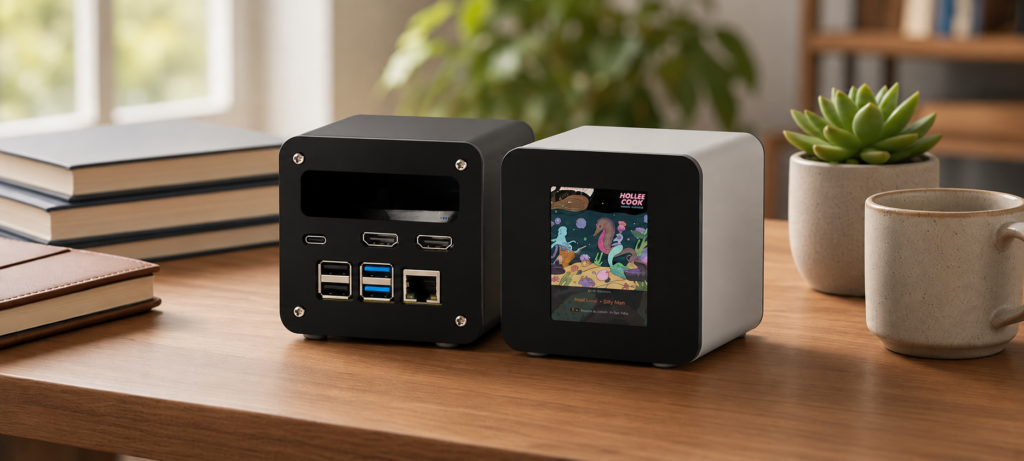
Raspberry Pi and single-board computer (SBC) projects have exploded in popularity among makers, hobbyists, and small-scale producers. Yet one persistent challenge remains: finding a clean, robust, and flexible enclosure system that scales with your ideas rather than constraining them. The PIXIS Project was created to solve exactly that problem.
PIXIS is an open-source platform that delivers professional-grade cases and carrier boards specifically designed for Raspberry Pi and compatible SBCs. It gives makers a versatile foundation for everything from simple prototypes to more complex, multi-HAT builds—without forcing them to reinvent the mechanical and interconnect details every time.
A Purpose-Built Platform for Real Projects
At the heart of the system sits the EXT90 Case, an extruded anodised aluminium enclosure measuring a neat 90 × 90 × 90 mm. Available in silver or black, the case looks sharp on a desk or in an installation while offering the durability aluminium provides. Inside, Raspberry Pi boards (or many of the popular Pi-compatible SBCs) mount on purpose-designed carrier boards, with room for up to three HATs.
Two primary carrier boards cover the main form factors:
CB-1 supports the smaller Pi Zero / Pi 3A+ footprint.
CB-2 supports the larger Pi 4 / Pi 5 form factor and includes a PCIe M.2 socket so you can add NVMe solid-state storage on a Pi 5.
This modular approach is one of PIXIS’s strongest advantages. You can swap between a Pi Zero, Pi 3A+, Pi 4 or Pi 5 (and boards with the same footprints) inside the same mechanical enclosure. Your project’s overall form factor and mounting strategy stay consistent even as the electronics evolve.
Thoughtful Design Details That Save Time
Several practical features make PIXIS stand out from generic cases:
All cables enter and exit cleanly through the rear panel. This keeps the front of the project tidy and makes cable management far simpler in finished builds or multi-unit installations.
Front and rear panels are available as high-gloss black acrylic, either blank (so you can machine them yourself) or pre-cut for common connector layouts. Full CAD and CAM files are freely available for CNC, laser cutting or 3D printing, so you can customise panels to suit any specific project.
Expansion is built in. The carrier boards include Grove, QWIIC and EYESPI headers, giving straightforward access to a wide range of sensors, displays and modules. Optional 2.8-inch DSI or SPI IPS LCD displays (640 × 480 or 320 × 240) can be fitted for projects that need a local interface.
Two full-size 40-pin Raspberry Pi header options and the ability to mix full-size and half-size boards and HATs add further flexibility.
These details reduce the amount of custom wiring, breakout boards and mechanical improvisation that often consume time on maker projects.
Cross Platform Capability
PIXIS also bridges the Raspberry Pi platform with the wider world of maker electronics. The carrier boards provide connectors for modules and sensors from the Arduino, Seeed, Grove and EYESPI ecosystems, taking care of the interconnects and power requirements for supported devices. This makes it easier to combine components from different ecosystems, reuse familiar modules and choose sensors or displays that suit the application. By reducing custom wiring and power-supply integration, PIXIS helps makers move from a working prototype to a tidy, repeatable build with significantly less effort.
Open Source by Design
PIXIS is deliberately open. Schematics, CAD files and reference designs are published on GitHub and OnShape. Makers can download the files, modify them, manufacture their own parts, or simply use the ready-made components available from the PIXIS store. The project also maintains a forum where users share designs, troubleshooting tips and collaborative ideas.
This openness lowers the barrier between prototype and finished product. Instead of guessing at clearances, connector positions or thermal paths, you start with proven mechanical and electrical layouts. The same files that let an individual maker experiment also support small-batch production runs—something the project actively encourages with discounts for modest quantities.
One Platform, Many Applications
Because the mechanical platform remains constant while the electronics and panels can change, PIXIS lends itself to a wide range of use cases. Audio projects, robotics controllers, home or industrial automation nodes, digital signage players and custom embedded controllers all fit comfortably inside the same 90 mm cube. The clean rear-exit cabling and robust aluminium body make the system suitable for both laboratory benches and more permanent installations.
Built for Makers Who Want to Ship
Many enclosure solutions force a choice between cheap plastic boxes that look temporary and expensive custom metalwork that only makes sense at higher volumes. PIXIS occupies a useful middle ground: pro-grade materials and thoughtful engineering at a maker-friendly price point, backed by complete design files so you are never locked into a single supplier or revision.
The combination of modular carrier boards, standardised case geometry, rear cable management and open documentation means less time spent on mechanical redesign and more time spent on the actual functionality of the project. Whether you are iterating quickly on a personal build or preparing a small run of devices, the platform is designed to stay out of the way and let the idea move forward.
Getting Started
The PIXIS store stocks the EXT90 cases, CB-1 and CB-2 carrier boards, acrylic panels and related accessories. All design files remain freely available for those who prefer to fabricate their own parts or adapt the designs further. The PIXIS Forum provides a space for questions, shared modifications and collaboration.
In short, PIXIS offers Raspberry Pi and SBC makers a coherent, expandable and open foundation. It replaces ad-hoc enclosures and scattered breakout solutions with a single, well-documented platform that scales from first prototype to small production. For anyone tired of reinventing the mechanical layer of every new project, it is a practical and welcome addition to the maker toolkit.
If you are building with Raspberry Pi or compatible boards and value both flexibility and a clean finished result, the PIXIS system is well worth exploring.